
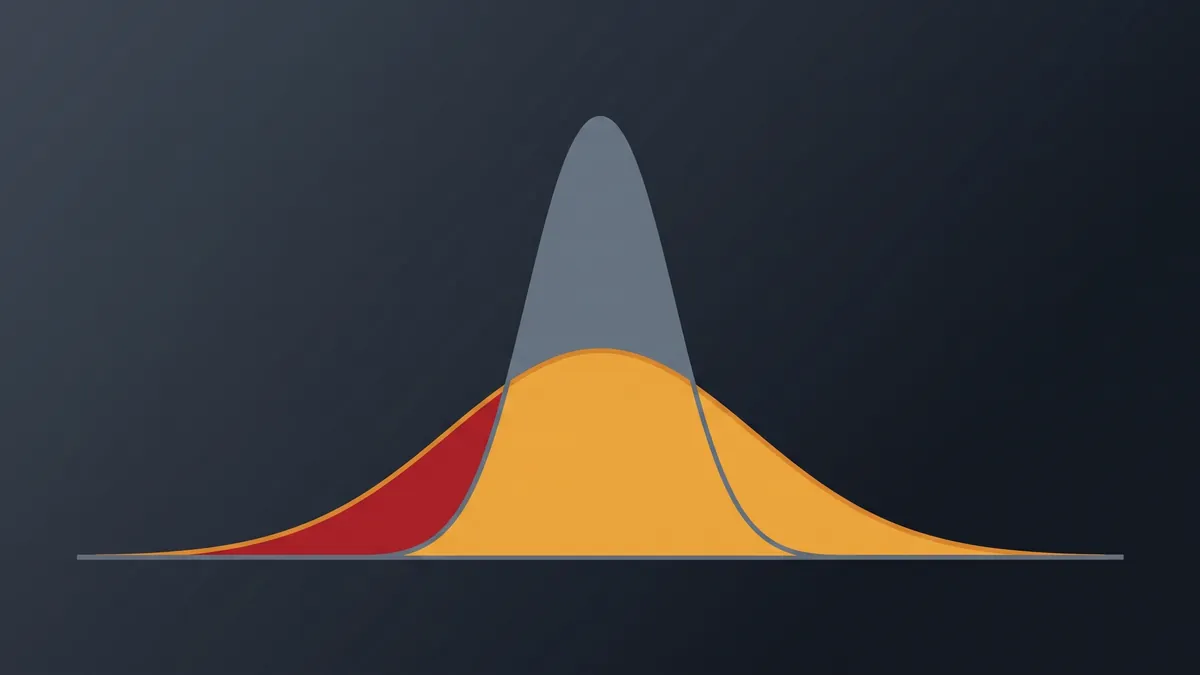
RTP tells you how much a slot returns over its full cycle. Volatility tells you how it gets there — and it is the number that actually decides what a session feels like.
Two slots can both run at 96% and behave nothing alike. One pays small amounts constantly; the other pays almost nothing for hundreds of spins and then pays a great deal at once. Same expected return, completely different experience, and completely different bankroll requirements.
The three bands
| Volatility | Hit frequency | Typical top win | What it feels like | Example |
|---|---|---|---|---|
| Low | 25–35% of spins | 200–1,000× | Steady small returns; bankroll erodes slowly | Starburst (500×) |
| Medium | 20–25% | 1,000–5,000× | Mixed, with occasional dead patches | Rainbow Riches, Fluffy Favourites |
| High | 15–20% | 5,000×+ | Long dry spells punctuated by large hits | Book of Dead, Big Bass Splash |
| Extreme | 10–15% | 10,000×+ | Brutal; most sessions end at zero | Nolimit City and Hacksaw titles |
Why the distinction matters more than RTP
Consider £100 at £1 a spin on two 96% slots. On the low-volatility game you will likely still be playing after 150 spins, having won small amounts perhaps forty times. On the extreme-volatility game there is a realistic chance the £100 is gone in 80 spins with almost nothing returned — and an equally real chance a single feature returns £2,000.
Both games return 96% across millions of spins. Neither is more generous. But only one of them lets a £100 bankroll survive an evening, and that is the practical decision volatility makes for you.
How to read a slot's volatility
- The paytable. Many studios now state it directly, often as a 1–5 star rating.
- The max win. The single most reliable proxy. A 500× ceiling means low volatility; 10,000×+ means extreme, regardless of what the marketing says.
- The bonus frequency. If a free spins round triggers roughly every 150 spins, it is high volatility. Every 60–80, it is low to medium.
- The paytable spread. If the top symbol pays 50× and the lowest pays 2×, the game is flat and low variance. If the top pays 500× and the rest pay under 5×, everything depends on one symbol.
Matching volatility to your bankroll
A workable rule: your bankroll should cover at least 200 spins at your chosen stake on a low-volatility game, 300 on medium, and 500 on high. Below that, variance rather than RTP decides your outcome — and variance is not on your side over a short session.
| Bankroll | Low volatility | Medium | High volatility |
|---|---|---|---|
| £50 | £0.20 a spin | £0.15 | £0.10 |
| £100 | £0.50 | £0.30 | £0.20 |
| £250 | £1.00 | £0.80 | £0.50 |
| £500 | £2.00 | £1.50 | £1.00 |
Where the stake cap changes this. UK-licensed slots are capped at £2 a spin, which enforces a crude form of bankroll discipline. Offshore sites have no such cap, so the responsibility moves entirely to you — and high-volatility games at high stakes are the fastest way to empty an account that exists.
Volatility and bonus wagering
This is the part almost nobody accounts for. If you are clearing a 40× wagering requirement, volatility works against you twice: high-variance games are far more likely to wipe the balance before the requirement is met, and the max-bet rule prevents you from betting large enough to clear it quickly.
For clearing bonuses, low volatility is almost always correct. Starburst is the industry's default free-spins game precisely because its low variance makes the operator's exposure predictable — and that same predictability works in your favour when grinding wagering. See our wagering guide.
The relationship with RTP
Volatility and RTP are independent. A 94% slot can be low volatility and a 97% slot can be extreme. You need both numbers to know what you are playing, and only one of them — RTP — is something the operator chooses.
Volatility is fixed by the studio and cannot be altered by the casino. RTP frequently can be. That makes volatility the more reliable of the two figures, and RTP the one worth checking every single time. How to check RTP →
Where volatility comes from
Volatility is a consequence of how a studio distributes a game's return. Every slot has a total return budget defined by its RTP, and the designer chooses how to spend it: a little to many players, or a great deal to very few.
The mechanism is the paytable and the hit frequency. A low-volatility slot pays the top symbol perhaps 50× and pays something on a third of spins. A high-volatility slot pays the top symbol 500× or more, pays nothing on four spins in five, and hides most of the return inside a feature that triggers rarely.
Both can return 96%. Neither is more or less honest than the other. They are simply different distributions of the same total.
How the return is split
| Volatility | Return from base game | Return from features | Feature frequency |
|---|---|---|---|
| Low | 70–85% | 15–30% | 1 in 60–90 spins |
| Medium | 50–70% | 30–50% | 1 in 100–150 |
| High | 30–50% | 50–70% | 1 in 150–250 |
| Extreme | 20–35% | 65–80% | 1 in 250–400 |
This table explains a great deal of how a game feels. On an extreme-volatility slot, up to 80% of the money the game will ever return sits inside a round you may not reach in a session. The base game is not broken — it is designed to be barely rewarding, because the budget is elsewhere.
Volatility and the £2 cap
Here is a point that gets missed. The UK stake cap does not reduce volatility — it cannot, because volatility is fixed by the studio. What it does is limit how much you can lose per unit of variance.
Offshore, with £100 spins available on an extreme-volatility game, the same distribution operates on stakes fifty times larger. The odds are identical; the speed at which an account empties is not. This is the single most important practical difference between UK and offshore slot play, and it has nothing to do with RTP.
What a session actually looks like
Take £200 at £1 a spin on three games, all at 96% RTP.
| Low volatility | High volatility | Extreme | |
|---|---|---|---|
| Typical spins survived | 400+ | 200–250 | 100–150 |
| Sessions ending near even | Common | Uncommon | Rare |
| Sessions ending at zero | Uncommon | Common | Most |
| Chance of a 100×+ win | Very low | Moderate | Meaningful |
| Median outcome | Slow decline | Zero | Zero |
The extreme column is worth reading twice. The median outcome — the most likely single result — is zero, and the average is only pulled up to 96% by the rare enormous wins that most players never see. That is not a criticism of the game. It is what extreme volatility means, and it is exactly what the marketing does not say.
Named examples across the range
- Low — Starburst (500× max), Blood Suckers, Twin Spin. Sessions last; wins are modest.
- Medium — Rainbow Riches, Fluffy Favourites, Gonzo's Quest.
- High — Book of Dead (5,000×), Big Bass Splash, Gates of Olympus.
- Extreme — Nolimit City's Fire in the Hole and San Quentin, Hacksaw's Wanted Dead or a Wild, most Megaways titles.
Choosing deliberately
There is no correct answer, only a correct match between the game and what you want from an evening.
- Want a long session on a small budget? Low volatility. You will not win big and you will still be playing in an hour.
- Want a realistic shot at a large win and accept most sessions ending at zero? High or extreme — but size the stake so that a dead session is affordable.
- Clearing a bonus? Low volatility, without exception. High variance is the main reason wagering requirements are never completed.
- Not sure? Medium. It is medium for a reason.
The mismatch that costs people money is playing extreme-volatility games at stakes sized for low-volatility ones. A £100 bankroll at £2 a spin on a Nolimit City title is 50 spins on a game that averages a feature every 300. The maths never gets a chance to happen.
Reading it before you play
Max win is the fastest proxy and it is usually on the first screen of the paytable. Under 1,000× is low to medium. Between 1,000× and 5,000× is high. Above 10,000× is extreme, whatever the marketing calls it.
Then check the RTP on the same screen, because you need both numbers and only one of them is the operator's choice. RTP guide →
If you joined GamStop because gambling was becoming a problem, this page is not for you. GamStop exists because it works. Free, confidential help is available from GamCare on 0808 8020 133, and from BeGambleAware.